An MIT study from 2025, repeated across half the market since, found that roughly 95 percent of corporate generative AI pilots produced no measurable P&L impact. Not because the models fail. Because the pilot sat next to the system where the company actually works. The model answered in a chat window, and the task still sat on someone's list, in another tool, with no owner and no trace in the history.
In June 2026 Anthropic published a partner program that measures exactly that problem from the supply side. We read the thresholds and drew a conclusion that is uncomfortable at our size and useful for our customers. This article is about that conclusion and what follows from it for companies already running monday.com.
The three numbers Anthropic uses to measure services firms
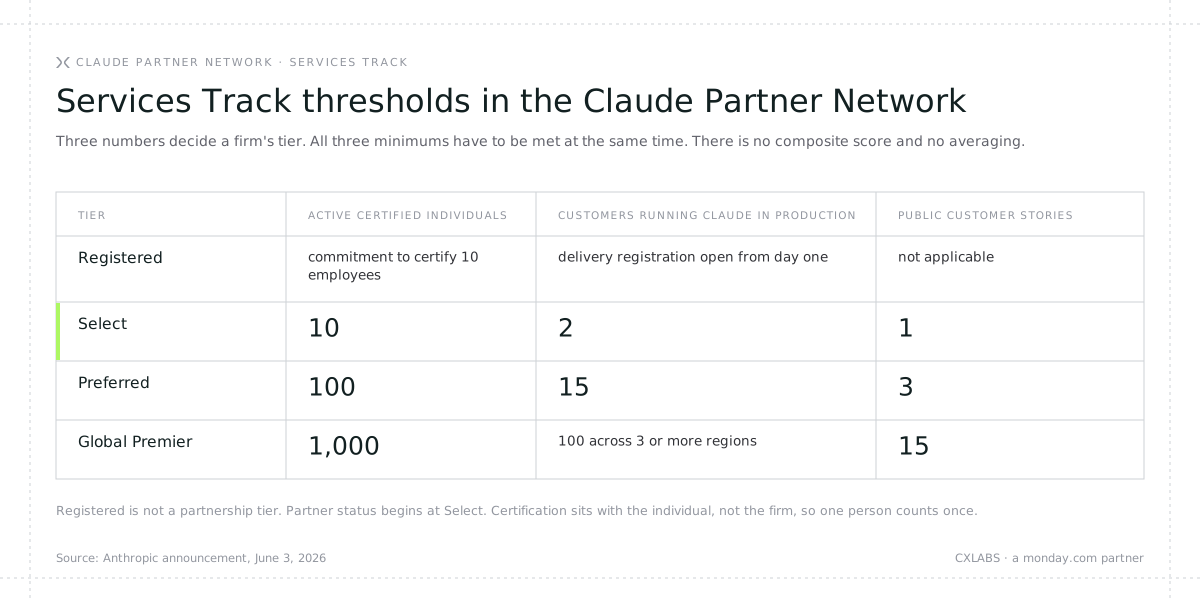
On June 3, 2026, Anthropic announced the Services Track of the Claude Partner Network along with the Claude Partner Hub. The program measures services firms with three numbers: how many active certified individuals they have, how many customers are running Claude in production over the trailing twelve months, and how many public customer stories they have published. Anthropic describes it as "a tiered structure that reflects what a firm has actually built and delivered with Claude."
Two things about this design are rare. First, the numbers are public, so any customer can check what a tier actually means. Second, certification belongs to the individual, not the firm. There is no arrangement where one certified person covers a team of 10.
Thresholds that tell you who the program is for
Select, the first partner tier, requires at least 10 active certified individuals, two customers with a production deployment in the trailing twelve months, and one public customer story. Preferred requires 100 certified individuals, 15 deployments, and three stories. Global Premier requires 1,000 certified individuals, 100 deployments across three or more regions, and 15 stories.
At launch, Anthropic named Accenture, Cognizant, Deloitte, Infosys, KPMG, and PwC as the largest professional services firms building Claude practices.
We'll be blunt here, because marketing material rarely is. At 100 certified individuals for Preferred and 1,000 for Global Premier, this program was not built for firms our size and never will be. The upper tiers are aimed at global consultancies, and the launch list says so. If you came here for an announcement that CXLABS joined the club next to Deloitte, you won't find it.
That is exactly why we read the program closely instead of ignoring it. For us it is a map of what Anthropic considers competence fit for production. That map has no entry fee, and it is not reserved for firms with 1,000 consultants.
The certification our team is taking
We build agents in monday.com on customer projects, and no program changed that. What changed is that the same work now rests on something a customer can verify.
The Anthropic path has two tiers, and they are worth separating, because confusing them is the most common overclaim in this industry. The first tier is the Anthropic Academy courses, all publicly available: "Introduction to agent skills," "Building with the Claude API," "Introduction to Model Context Protocol," and "Claude Code in Action." Anthropic Education issues a certificate of completion for each one with a public verification link, so anyone can check who finished which course and when. Those courses are behind us, and those links are ours to show.
The second tier is the certification exams, and that is a different league. They test a specific skill, they are proctored with identity verification before the start, and the credential goes to the individual as a digital badge. Only this tier counts toward a firm's standing in the Anthropic program. Members of the CXLABS team are preparing for these exams.
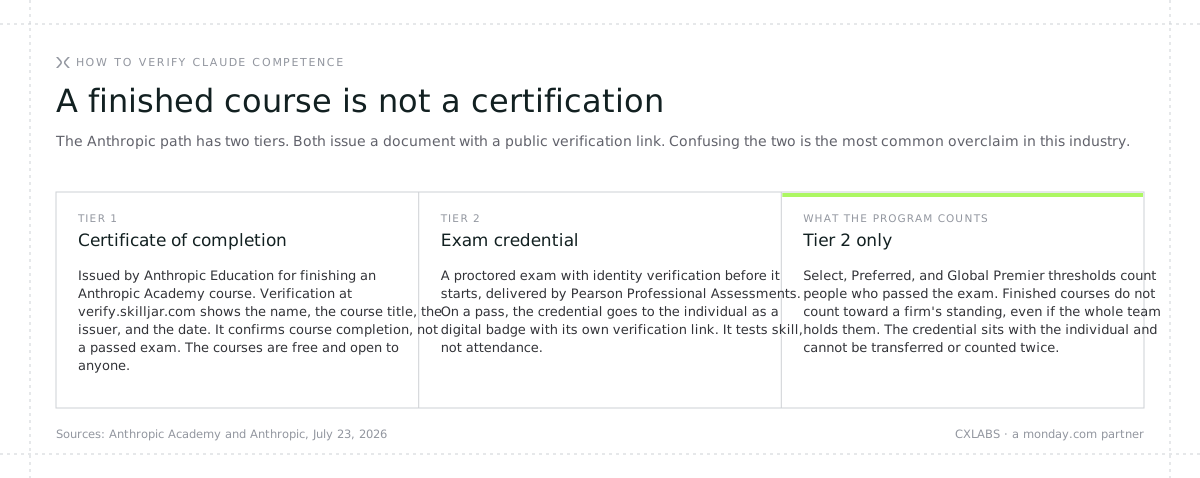
Anthropic offers four role-based certifications. Claude Certified Associate: Foundations, for consultants and project leads. Claude Certified Developer: Foundations, for engineers building on the Claude API. Claude Certified Architect: Foundations, for architects designing agent systems. Claude Certified Architect: Professional is the advanced credential, for enterprise-scale deployments, covering integration architecture, oversight, and evaluation. The exams are delivered by Pearson Professional Assessments, and the badge on a pass comes from Credly.
Two features of this design matter to a customer, not just to us. The credential sits with the individual rather than the firm, so nobody can buy 10 certifications and hand them out to a team, or count one person 10 times. And, as Anthropic states, certified practitioner counts determine a firm's standing in the Claude Partner Network. That is the same counter the program runs on global consultancies, only counted from one person up.
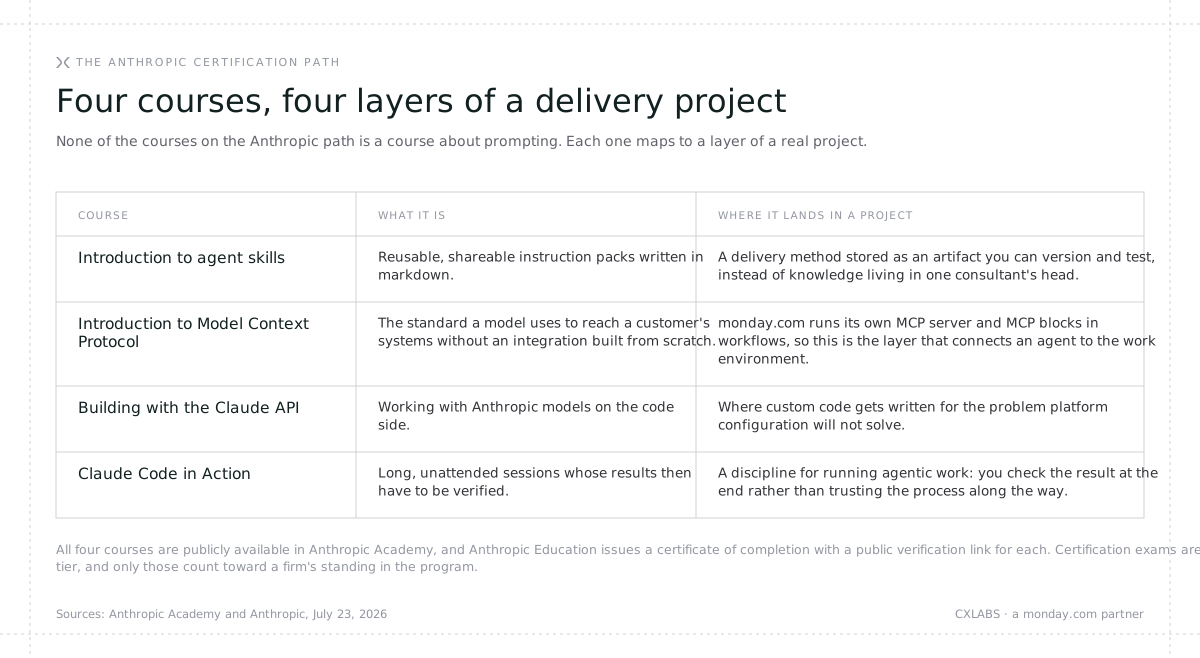
Four courses, four layers of a delivery project
None of these courses is a course about prompting. Each one maps to a layer of a real implementation.
Agent Skills are reusable, shareable instruction packs written in markdown. For a delivery firm that is not a curiosity, it is a way to store a delivery method in a form a machine executes. Our standard for configuring a project board in monday.com stops being knowledge in one consultant's head and becomes an artifact you can version and test.
Model Context Protocol answers the question of how a model reaches a customer's systems without building an integration from scratch every time. monday.com runs its own MCP server, and in July 2026 it added MCP blocks in workflows, describing them as a way to securely connect AI tools and agents to monday.com with the right permissions.
Claude API is the layer where code gets written for the problem platform configuration won't solve. More on that below.
Claude Code is about long, unattended sessions that have to deliver a result and then be verified. It is a discipline rather than a tool, and it carries over directly to how a project is run.
This is a curriculum we would have designed ourselves given a year. Anthropic did it for us and made the courses free.
The author's certificates for all four courses, verifiable without asking us for anything:
- Introduction to agent skills: verify.skilljar.com/c/giicjn93m9s3
- Introduction to Model Context Protocol: verify.skilljar.com/c/w9yb8r2pzmsz
- Building with the Claude API: verify.skilljar.com/c/zmb45st45849
- Claude Code in Action: verify.skilljar.com/c/5ypkz32enhjy
Each link opens an Anthropic Education verification page with the course title and the completion date. This is the first tier of the path, not the certification exam, and we are not pretending otherwise.
What changes when a certified architect runs the project
The honest answer is that a certificate does not implement anything and is not a guarantee. It changes three specific things about how a project runs.
An agent's permission scope stops being set by trial and error. It starts from the question of what minimum the agent needs, rather than granting access to everything and narrowing it later once something goes wrong. That difference shows up in an audit, and by then it is expensive.
The line between configuration and code gets drawn before the quote rather than halfway through the project. Someone who knows the Claude API and MCP can say in the first week that a given integration is not an automation case, and what building it actually costs.
And the least glamorous one: you know how to check whether the agent did what it was supposed to do. The Claude Code course is largely about the fact that a long, unattended session needs its result verified rather than its process trusted. That carries over directly to a project.
monday.com as the company's operating system, code for the rest
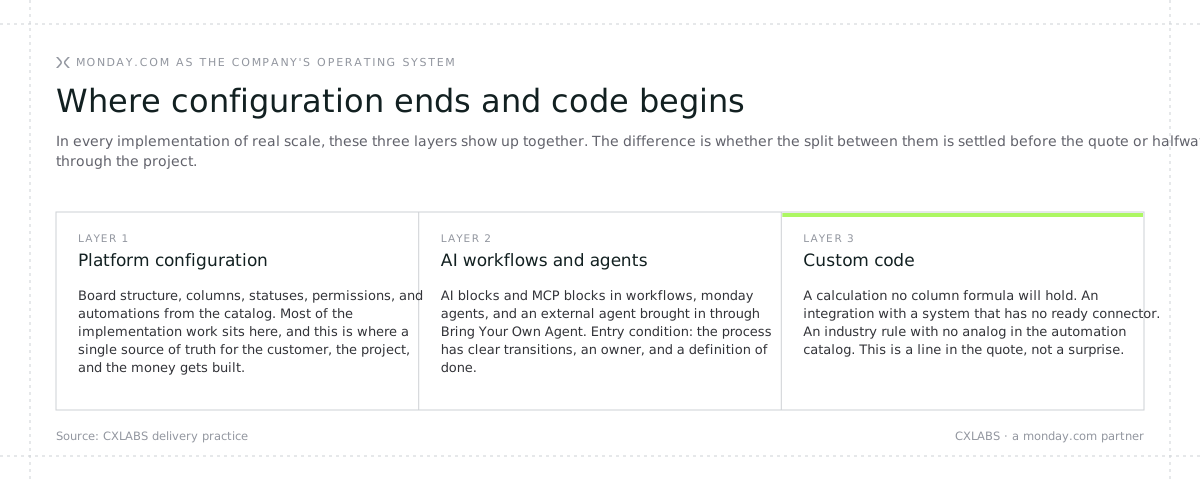
We treat monday.com implementations as building an operating system for running the company, not as buying a task tool. The difference is practical, and it shows up in the first week of a project. A task tool gets implemented by switching accounts on. An operating system gets implemented by settling where the customer is recorded, where the project is recorded, where the money is recorded, and what counts as the single source of truth for each.
At that level, most of the work is platform configuration and automation. But not all of it. Every implementation of real scale leaves work that configuration cannot close: a calculation no column formula will hold, an integration with a system that has no ready connector, an industry rule with no analog in the automation catalog. That is where code comes in.
We are direct about this during the audit, because it belongs in the quote rather than in a surprise halfway through. The customer learns before signing which three items on their list need code, what that costs, and what happens if we do not build it. Competence in the Claude API and MCP lands exactly there, and it shortens that line rather than creating it.
A Claude agent as its own identity in monday.com
This is the section worth reading this far for. monday.com isn't announcing external agents. It documents them and ships them.
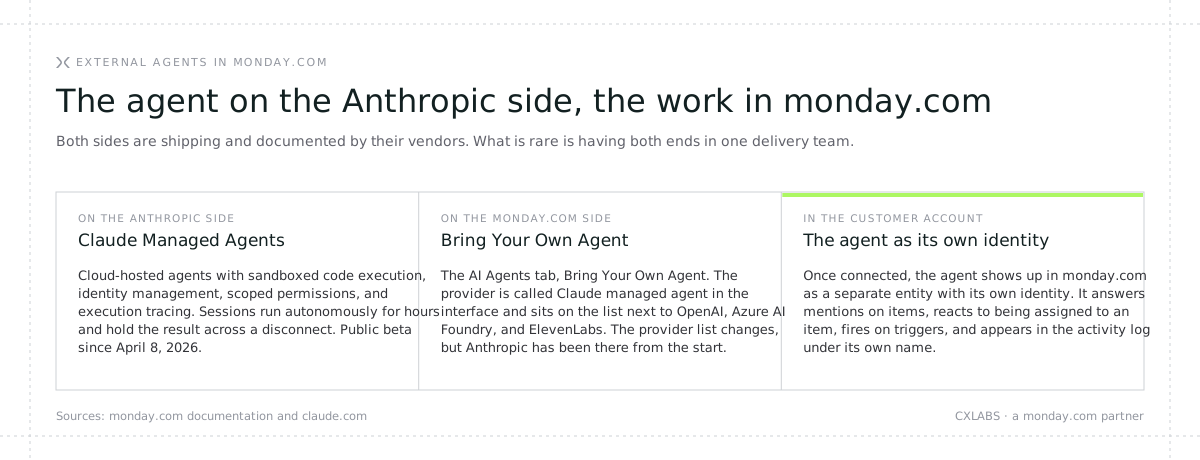
The AI Agents tab has a Bring Your Own Agent feature. The provider is called Claude managed agent in the interface, and it sits on the list next to OpenAI, Azure AI Foundry, and ElevenLabs. The provider list changes, so there is no point transcribing it in full, but Anthropic has been there from the start. Once connected, to quote monday.com's documentation, the agent "shows up in monday.com as a separate entity with its own identity." It answers mentions on items, reacts to being assigned to an item, fires on triggers, and appears in the activity log under its own name.
Up to this point we have been quoting vendor documentation, because that is how you write about someone else's product. Below is a recording from our own environment: connecting a Claude managed agent to a monday.com account, from picking the provider to the state where the agent is active with triggers set to mention and assign. The moment that matters is the one with the key and the permission scope, because that is where the decision an IT director asks about gets made.
The permission model an IT director asks about
This is usually the first question in the room, and monday.com answers it in one sentence of documentation: "By default a connected agent has no access to any content in your account." Access is granted explicitly, item by item. An admin can deactivate any external agent at any time from the admin section. Every agent action lands in the activity log with its identity, so the question of who changed a status has an answer even when an agent changed it.
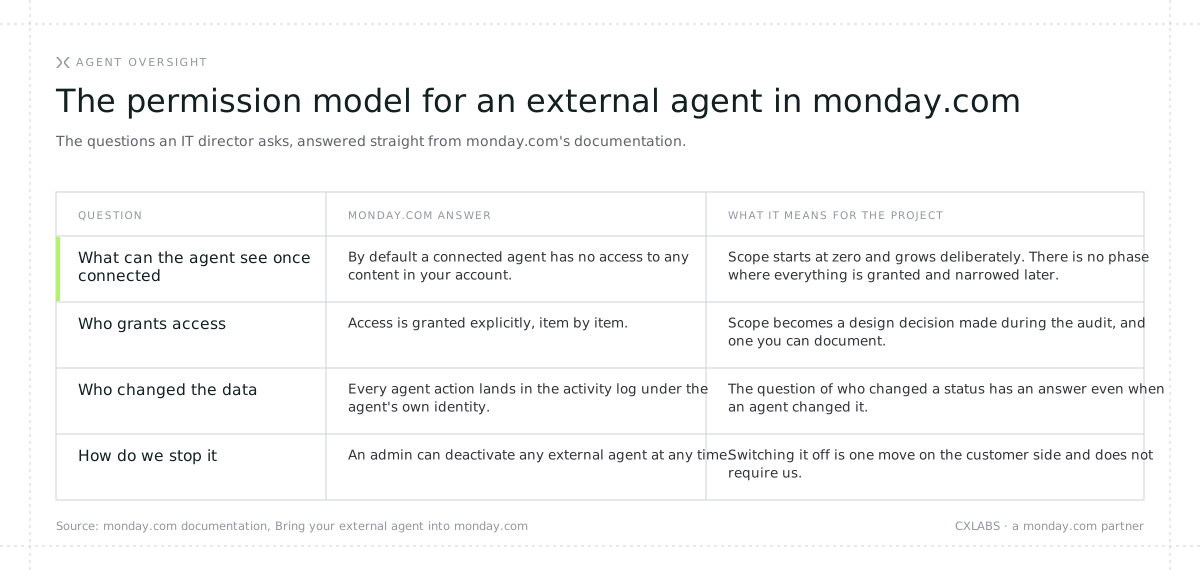
On the Anthropic side, this is matched by Claude Managed Agents, in public beta since April 8, 2026. Anthropic describes them as cloud-hosted agents with production infrastructure included: sandboxed code execution, identity management, scoped permissions, and execution tracing, with sessions that run autonomously for hours and hold the result across a disconnect.
Both halves are shipping and documented. What is rare is having both ends in one delivery team: the work environment in monday.com and the agent on the Claude side. That is where we work, and certification deepens that work rather than opening the door to it.
One day after, in three different companies
Architecture is not a reason to change. A working day that looks different is. Three scenes, because a company's operating system looks different in a services firm, a manufacturer, and a field service business, and an agent enters each one at a different point.
A services firm running customer projects. The coordinator doesn't collect statuses in the morning. They mention the agent on the project board and get an update listing overdue tasks, split into blocked by the customer and blocked internally, plus one question that needs a decision. Three minutes, without opening three boards.
A manufacturer. The planner doesn't retype deviations into a spreadsheet. On Monday morning an automation assigns the agent an item called "order review," which is what starts it. The agent reads the coordination board and returns the list of orders at risk, split into missing material, quality holds, and changeovers. monday.com does not hold production system data on its own, so this scene needs an integration. That is exactly the layer-three line described above, which is why it goes into the quote before the project rather than halfway through it.
A field service business. The dispatcher doesn't work through an inbox. Tickets land on a board, and the agent flags the ones approaching an SLA breach, suggests a technician based on region and availability, and drafts the reply to the customer. A person approves or edits it. The reply is created next to the ticket rather than in someone's inbox, so the next person doesn't have to ask what was agreed to.
In all three cases there is one more person nobody talks about during a demo. The CFO sees a project, an order, or a ticket where hours, budget, and invoice sit in one record, and doesn't have to take it on faith that the data is current. They can check who last touched it and when, a person or an agent.
Nobody in that picture was clicking through a board on Friday evening. That is the whole difference, and it counts in hours rather than in impressions.
What this means if you already run monday.com
If monday.com is in place and the question is what's next, the answer does not start with a new license. It starts with a review of what you already have, against one criterion: which processes are described in monday.com precisely enough for an agent to execute, and which are described only in people's heads.
That distinction decides everything. An agent works on structure. If a status called "in progress" means five different things at your company depending on who set it, no model will fix that, and it is not worth spending money on. If a process has clear transitions, an owner, and a definition of done, it is a candidate for a first agent, and it can be done in weeks rather than quarters.
In the audits we run, that split usually comes out lopsided. Some processes are ready immediately, some need configuration work that was overdue anyway. We say this before the quote, not after.
What this means for the team
We work AI-first, and that is not website copy. It means the default question on any task is whether a person should be doing it, and certification is how the answer to that question rests on knowledge rather than instinct.
For anyone considering working with us, that is concrete: you work on monday.com implementations where an agent is part of the architecture rather than a topic for later, and you take the same certification path Anthropic laid out for delivery firms. The credential stays with the person, not the firm, and that is the right arrangement. The competence you build here is yours.
Book a short discovery
Start with one process, not a whole implementation. Book a short discovery call, 30 minutes, and bring a process a person currently closes by clicking: handing a sale over to delivery, approving materials, the weekly review, whichever fits. Describe it once, the way it works rather than the way it looks in the procedure.
You'll leave with two things. An answer on whether this is a case for configuration, for an AI workflow, or for an external agent. And a list of what the process is missing before an agent can take it over.
We'll help you set up the first step, and we won't attach a whole program to it. A process map and a quote are the next step, if you propose it after that conversation.
If your process turns out to be described too thinly to hand to an agent, we will say so, and we will not sell you an agent. Putting the structure in order costs less in that case and returns more. If it turns out you do not have this problem at all, run the numbers again in a year, when you have twice the projects with the same number of people.
Frequently asked questions
Can a Claude agent work in monday.com today?
Yes. monday.com ships the Bring Your Own Agent feature in the AI Agents tab, and Claude managed agent is on the provider list. Once connected, the agent has its own identity in the account, answers mentions, reacts to being assigned to an item, and fires on triggers.
How is an external agent different from monday AI agents?
monday agents are built and maintained by monday.com and operate within the platform. An external agent is built at the provider you choose and brought into monday.com through Bring Your Own Agent. The practical difference is where the agent's logic runs and how far it reaches beyond monday.com.
What permissions does an AI agent have in monday.com?
According to monday.com's documentation, none by default. A connected agent has no access to content in the account until access is granted explicitly. An admin can deactivate the agent at any time, and its actions are visible in the activity log under its own identity.
Do you need an Anthropic certification to run a Claude agent in monday.com?
No. Certification is not a technical requirement. What it changes is who designs the agent's permission scope, how its system prompt is written, and what happens when the agent does something unforeseen. Those are design decisions rather than configuration ones, and that is where the difference shows.
How do I check whether someone really holds a Claude certification?
Ask for the verification link rather than a screenshot, and check which of the two documents you are getting. A certificate of completion for an Anthropic Academy course verifies at verify.skilljar.com and shows the person's name, the course title, Anthropic Education as the issuer, and the completion date. An exam credential is a digital badge with its own public link, issued after a proctored exam. Both are real, and both are worth showing, but they mean different things: the first confirms a finished course, the second a passed exam. Only the second counts toward a firm's standing in the Claude Partner Network.
What is the Claude Partner Network?
Anthropic's partner program for firms that put Claude into production for customers. The Services Track, announced on June 3, 2026, has Registered, Select, Preferred, and Global Premier levels, and advancement depends on the number of active certified individuals, the number of customers with a production deployment, and the number of public customer stories. Anthropic published the thresholds for each level.
Is monday.com actually a company's operating system, or just a task tool?
It depends on how it gets implemented. As a task tool it works from day one, and that is how most companies end up with it. As an operating system it requires settling a single source of truth for the customer, the project, and the money, and that is a project rather than an account setup. The second version is the precondition for an AI agent having anything to work on.
Sources
Every hard number in this article comes from a vendor rather than an industry summary. Links to check:
- Anthropic, announcement of the Services Track and the Claude Partner Hub, June 3, 2026: anthropic.com/news/services-track-partner-hub, tier thresholds for Select, Preferred, and Global Premier, and the launch partner names
- Anthropic, four role-based certifications, July 23, 2026: claude.com/blog/four-role-based-claude-certifications, certification names, proctored exams, Credly badges, and the statement on certified practitioner counts determining a firm's standing
- Claude Partner Network, program page: claude.com/partners
- Anthropic Academy, courses: anthropic.skilljar.com
- Anthropic, Claude Managed Agents, public beta since April 8, 2026: claude.com/blog/claude-managed-agents
- monday.com, Bring your external agent into monday.com: support.monday.com, the provider list, the agent's own identity, no access by default, and deactivation by an admin
- monday.com, announcement on unifying AI tools, July 8, 2026: monday.com/blog, MCP blocks in workflows
- MIT, 2025 report on returns from generative AI pilots, known as The GenAI Divide, produced under the NANDA initiative, the source of the 95 percent figure

Let’s talk about how CXLABS can help transform your ideas into innovative solutions, driving growth and success for your business!